New album by SABA ALIZADEH, a groundbreaking voice in contemporary Iranian music who blends classical Persian traditions with avantgarde experimentation.
Born in Tehran in 1983 as son of the world renowned tar and setar virtuoso HOSSEIN ALIZADEH, SABA ALIZADEH established himself not only as a true master on the Iranian spike fiddle kamancheh but one of the groundbreaking voices in contemporary Iranian music, blending classical Persian traditions with avantgarde experimentation. His music, praised by THE WIRE as “a bridge between the ancient and the contemporary”, turns sound and image into powerful narratives of memory and resistance. Over the past years, ALIZADEH (who relocated to the Netherlands a few years ago) has appeared at key festivals and venues such as Reeperbahn Festival, CTM, Flow Festival, Philharmonie Berlin, Kölner Philharmonie, solidifying his reputation as a singular live performer. After the critically acclaimed releases “Scattered Memories” (his international debut, released on Karlrecords in 2019), “I May Never See You Again” (2021) and last year’s “Temple of Hope”, his new album fascinates again with a unique artistic voice, weaving together centuries-old sonic heritage and the urgency of the present through deeply immersive, meditative landscapes in two epic pieces. “Rituals Of The Last Dawn” may feel like a sad or resigned title (compared to the positively fierce “Temple Of Hope”), but at the same time the highly meditative music provides a good lot of contemplative strength. Appealing to an open-minded “world music” audience as well as fans of current streams of ambient or drone in its most subtle forms, ALIZADEH’s latest work is a strongly needed soul food in bitter times. Created on the spot with his musical partners PIETRO CARAMELLI (guitar and electronics on “First Ritual”) and LIEW NIYOMKARN (lap steel and electronics on “Last Ritual”), “Rituals Of The Last Dawn” is a pure, unfiltered emotional expression from one of contemporary Iranian music’s leading artists.
Tracklist: A. First Ritual 23:04 B. Last Ritual 17:13
Credits: Mixed at NoiseWorks Studio, September 2025 Mastering & cut by Helmut Erler, mastering.heyrec.org Layout & design by kaidoh Calligraphy by Mohammad Enshai
First Ritual: Kamancheh: Saba Alizadeh Guitar, electronics: Pietro Caramelli Recorded at NoiseWorks, July 2025, Leiden
Last Ritual: Kamancheh: Saba Alizadeh Lap steel guitar, electronics: Liew Niyomkarn Recorded at Liew’s studio, July 2025, Brussels
“Tectonic” is a concise portrait of SIMON BERZ’s geological sound explorations across continents over the last 15 years: drums, electronics, and a set of electronically manipulated basalt stones from Iceland.
SIMON BERZ is a transdisciplinary drummer, sound artist, and music educator based in Switzerland and Berlin. Working at the intersection of improvised music, sound art, and performance, and deliberately crossing boundaries between disciplines, his aesthetics are shaped by a sustained engagement with natural materials, particularly stone, and their sonic transformation through electronic manipulation. Beyond his performance work, BERZ founded BADABUM as an art label and a music school. For the last 30 years, BERZ has been performing in Japan, China, Russia, the USA, Cuba, Iceland, Turkey, and across Europe. He has collaborated with artists includingBILL LASWELL, BABY SOMMER,DAMO SUZUKI (CAN), JAMES TURRELL, JIMI TENOR, JOHN SINGLAIR, JOJO MAYER (NERVE), KONDO TOSHINORI, KIDD JORDAN, LAUREN NEWTON, LEE “SCRATCH“ PERRY, MAURO PAWLOWSKI (dEUS), NILS PETTER MOLVÆR, NIKI GLASPIE, NORBERT MÖSLANG, PAUL LOWENS, PFADFINDEREI, ROB MAZUREK, SKÚLI SVERRISSON, and he was the live drummer for APPARAT. As BERZ understands artistic practice as energy emerging from nature and through dialogue with people, his recorded output is intentionally selective, with one highlight being “Beats versus Breath” with KONDO and LASWELL (2023). Alongside a regular drumkit and electronics, he has developed his own instruments such as the “Lithophon” in which resonating stones are turned into amplified sound through water drops, and “Tectonic”, a set of Icelandic basalt stones shaped through electronic manipulation. These self-built instruments form the material basis for his performances, installations, and sound recordings. “Tectonic” is also the title of BERZ’s latest work: a summary of his geological sound explorations across continents. From Iceland to Indonesia and Bali, from New Orleans to China, in caves and at shores, BERZ carried his millions-of-years-old basalt stones as both instrument and collaborator. On Java, he met Baron, a builder of stone gamelan instruments. At the Pacitan Tabuhan Cave (Indonesia) he performed with MISBACH BILOK and WUKIR SURYADI (SENYAWA) who work with corals as instruments. BERZ brought these encounters and “field recordings” to the Stöðvarfjörður studio in Iceland, where he recorded with his “Tectonic” set-up, drums, and electronics. The music was later mixed in Berlin by DIRK DRESSELHAUS (SCHNEIDER TM). The resulting album moves from club-driven tracks to ambient passages, from gamelan-inspired textures to HipHop-like beat patterns. It resists easy categorization while staying direct and physical in its impact.
Tracklist: A1. Deep Time A2. Cementation A3. Lithification A4. Awan Panas A5. Hiatus B1. Oshima ∞ B2. Emergent Terrain B3. Diferensiasi Gravitasi B4. Turbidite
Credits: Simon Berz: Drums, 5 Icelandic Basalt stones, ROCKING DESK:D.I.Y Instruments & Electronics, Field recordings All tracks composed & performed by Simon Berz Recorded by Vinnie Wood at Silo Recording Studios Stöðvarfjörður / Iceland, May 2025 Tracks B1, B4: Phyllit slide stones, electronicsrecorded on Izu Oshima / Japan Tracks A1, B2: D.I.Y Instruments, corals recorded at the Pacitan Tabuhan Cave / Java with guest performers Misbach Bilok, Wukir Suryadi Field recordings from Izu Oshima / Japan, Pacitan / Indonesia, Kjalvegur / Iceland, Arnarstapi / Iceland Mixed by Dirk Dresselhaus at ZONE, Berlin, Oct. – Nov. 2025 Mastering & lacquer cut by Helmut Erler, mastering.heyrec.org, Berlin, Nov. 2025 All photography by Andi Hofmann Layout & design by kaidoh
Benefit compilation with exclusive tracks from live performances & installations at eavesdrop festival 2024. All revenues go to charities providing medical aid and food sovereignty in Gaza.
In november 2024, eavesdrop festival presented its 3rd edition of contemporary electronic music and sound art, taking place in the striking architectural setting of silent green’s Betonhalle in Berlin. ”to eavesdrop” – is invoked as a mode of listening intently, attentively and with curiosity. With its ongoing commitment to adventurous listening cultures, the festival brought together a top-notch line-up of Berlin based and international artists, who share a common practice in electronic sound composition whilst spanning a diversity of inter-related contemporary tendencies. Whether it’s multi-award winning Mariam Razaei’s exceptional turntablism, Ilpo Väisänen’s legendary DIY analogue electronics, Jasmine Guffond’s generative sound installation, Nina Garcia’s extraordinary electric guitar manipulations, Lottie Sebes’ AI voice synthesis or Rashad Becker’s idiosyncratic synthesizer explorations, to name a few, eavesdrop invited listeners to consider, from multiple perspectives, new social and technical developments in international music and sound cultures. This compilation documents those 2 nights with 9 exclusive tracks – 7 live performances and 2 stereo mixes from multi-channel installations, edited by the festival’s curator / organizer Jasmine Guffond, with a total running time of approx. 78 minutes. All revenues will go to charities providing medical aid and food sovereignty in Gaza: Medical Aid For Palestinians & Thamra.
Tracklist: A1. Rashad Becker – Live excerpt fromeavesdropfestival, 2024 (7:38) A2. Mariam Rezaei – Live excerpt from eavesdrop festival, 2024 (9:36) A3. Audrey Chen & Hugo Esquinca – Live excerpt fromeavesdropfestival, 2024 (6:10) A4. Nima Aghiani – Live excerpt fromeavesdropfestival, 2024 (5:43) A5. Lottie Sebes – Mouthpiece (9:18) B1. Nina Garcia – Live excerpt from eavesdrop festival, 2024 (8:20) B2. Jasmine Guffond – Approaching Chaos (4:56) B3. Ilpo Väisänen – Live excerpt fromeavesdropfestival, 2024 (15:04) B4. Mat Pogo – Special Occasion (10:06)
Credits: All tracks recorded live at Silent Green, Berlin on november 6th & 7th 2024 as part of eavesdrop festival, 3rd edition except Mouthpiece & Approaching Chaos which are are stereo versions of multichannel installations, exhibited during the festival. Mastering by Rashad Becker at clunk, Berlin, november 2025 Artwork by Martin Müller / dicey-studios.com Tape layout by kaidoh
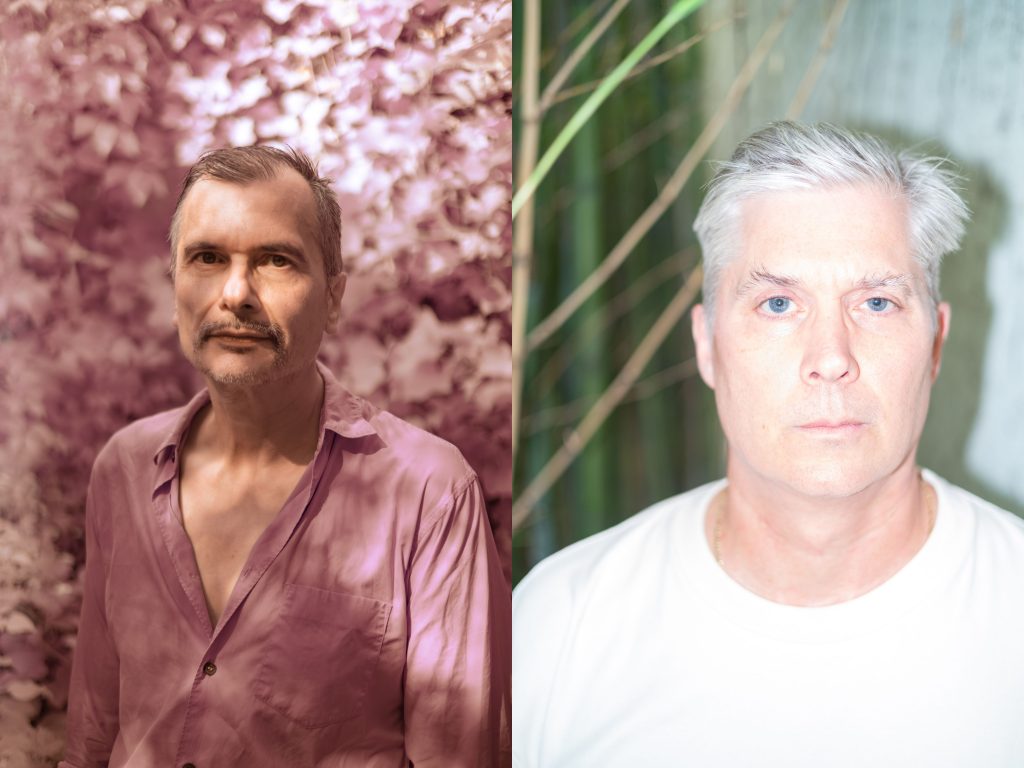
A new album by PERIODE, the duo of ANDREAS REIHSE (KREIDLER) and THOMAS WINKLER: yearning and thrilling, kraut-esque electronica that suggests the motion of travel.
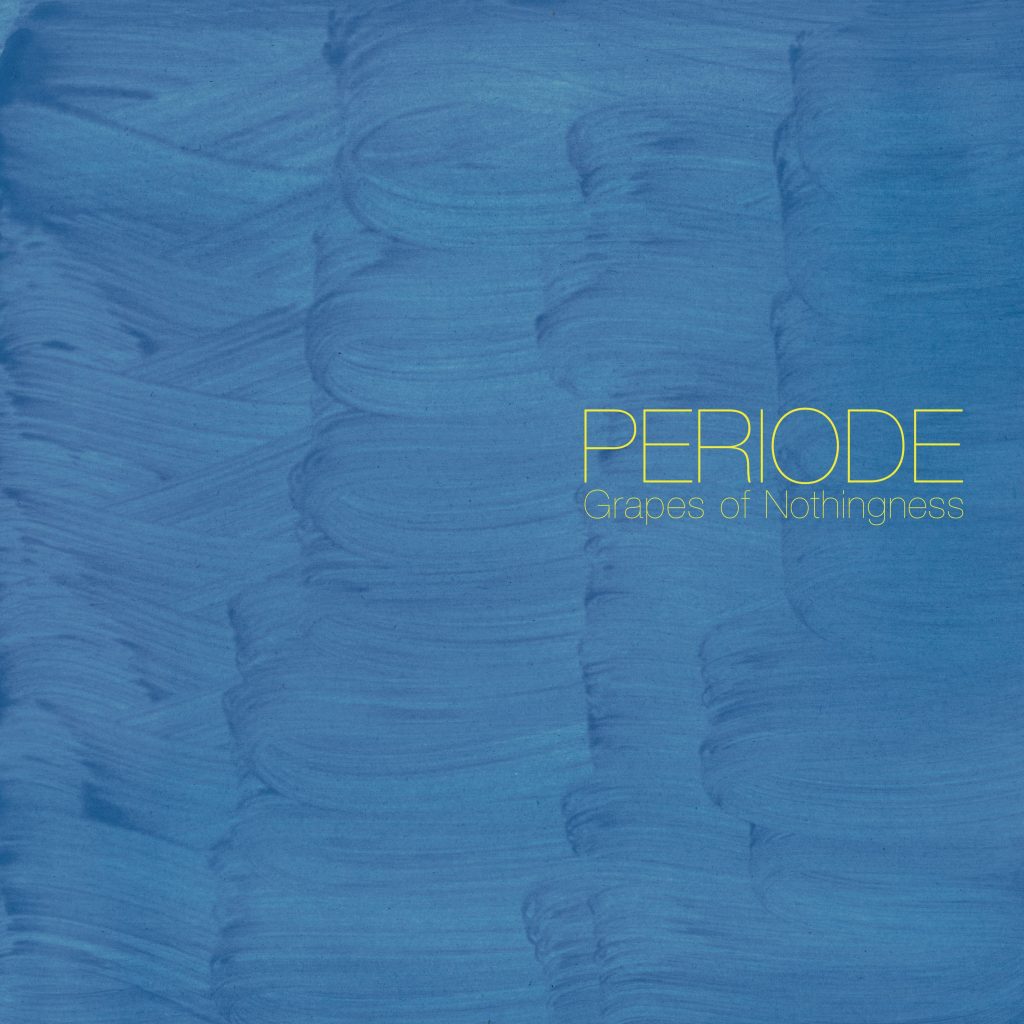
Working together as PERIODE since 2016, the duo of THOMAS WINKLER and KREIDLER founding member ANDREAS REIHSE has been refining its delicate sound over the course of 5 releases. The ingredients are as simple as effective: an old 70+ Telecaster guitar with a few weirdo-effect pedals, a drum machine, an audio interface that is connected to an overloaded laptop. WINKLER’s guitar patterns have a fragmented, almost haphazard connotation, searching in a shimmer of reverb, until REIHSE’s beats, the framework, set in to reveal structure. On the new album, WINKLER further expands these patterns by subtly honing the distinctive picking technique he originally learned in 1986 from a homeless man under the piers of Brighton — a ghostly imprint that now resurfaces with refined precision. REIHSE´s programmed rhythms go just to the point of a groove, holding the moment of tension, knowingly delaying the gratification. Beats that have a scratchy patina and an subtly playful edge; their crispness stands in clear contrast to the contemplative drift of the guitar. Their latest effort, “Grapes Of Nothingness” (actually the first that carries an album title!), is the most assured release by PERIODE so far. The nine tracks feel like a series of studies / variations on a mood: a profound melancholy, a certain bleakness — but never desperate. First impressions may suggest that this is nocturnal music, yet it can equally evoke the harsh sunlight and baking heat of a summer day. Or a rainy day. And the motion of travel with Superdelay – even if maybe only in the mind … however, it remains unclear whether the listener is moving through the world or whether the world is passing by the listener. There are some apparent references here: a good portion of Les Disques du Crépuscule, some kraut-esque electronica, even a smidgen of MORRICONE / Spaghetti Western, all blending into a kind of Musique Noir — yet these serve only as a set of orientational coordinates, rather than aesthetic quotations. Is it a trance? Or a dance? Yes.
Andreas Reihse is a Berlin based musician, mostly known as founding member of Kreidler. He also composes music for theater and film, occasionally writes, draws, and makes movies.
Thomas Winkler is a Berlin based musician, painter, photographer and performance artist. He cofounded the publishing house Heckler und Koch and the gallery European Fine Art.
Tracklist: A1. Das Siebte Pferd A2. Hohenschönhausen A3. Trains A4. Ravetruck A5. Grapes of Nothingness B1. Flipping the Buns B2. Holz B3. Club Chair B4. Periode No 6
Credits: Written, performed, recorded, mixed, produced by Periode 2024–26 Thomas Winkler, Andreas Reihse Feuer und Flamme für Berlin Studio, Paulick Saal, Barb32 Grapes of Nothingness tweaked by Alex Paulick at Spatialtone Mastering and Cut by Helmut Erler at Hey Rec Cover painting by Thomas Winkler periode.net/
Periode are Thomas Winkler and Andreas Reihse. Reihse is a Berlin based musician, known as founding member of Kreidler. Winkler is a Berlin based artist and musician.
(C) Ilja Niederkirchner
Andreas Reihse overtures and underlays Thomas Winkler’s hypnotic
guitar pickings with the digital grid of infinity that Winkler
repeatedly tries to touch and to break through. There is hardly any
singing.
Periode’s sixth release „Grapes of Nothingness“ is due in January 2026 on Karlrecords, here the advance track „Flipping The Buns“. Video created by Ronald Dick:
Berlin-based musician and media artist Michael Vorfeld celebrates the 20th anniversary of his unique sonic explorations with a new volume of his Glühlampenmusic (Light Bulb Music). Mastered by Rashad Becker.
Michael Vorfeld is a musician and media artist, plays percussion and self-designed string instruments, and realizes electroacoustic sound pieces. He works in the field of experimental, improvised music and sound art, realizing installations and performances with light and sound, and working with photography and film. In addition to his solo activities, he is a member of various ensembles and collaborates with artists who work in many different art forms, e.g. Burkhard Beins, Mazen Kerbaj, Ute Wassermann, Reinhold Friedl, to name a few. Based in Berlin, his list of activities includes numerous concerts, performances and exhibitions in Europe, America, Asia and Australia. Michael Vorfeld participated in the documenta 8, Kassel with the sound performance group “Heinrich Mucken“. Since the mid-1980s, Vorfeld has been realizing a multiplicity of partly site-specific light works (most of which also included sound) and where the incandescent lamp played an essential role. He conducted many tests to research the interplay of light and sound, experimented with all kinds of incandescent lamps in relation to various light-controlling devices and used many different types of microphones and pickups to “eavesdrop” into the acoustic potential of the various light events. The result of this research is Glühlampenmusik (Light Bulb Music), an electro-acoustic and audio-visual performance where sounds are generated through the use of different light bulbs and actuating electric devices. The incorporation of different analog light controllers such as switches, dimmers, relays, flashers and various others leads to diverse variations within the light event, made audible with the help of various microphones and pickups. The changes in the light intensity, the incandescence of the filaments and the rhythmic variety of the flickering and pulsing lights is directly transformed into a comprehensive and microcosmic electro-acoustic world of sound. First performed publicly under the title Glühlampenmusik in the Labor Sonor series at Kule, Berlin in January 2005, and released in 2010, this new volume of Glühlampenmusik celebrates its 20th anniversary of these sonic adventures that can range from sparse abstractionism to almost “clubby” pulsations.
Credits: All music composed, performed and recorded by Michael Vorfeld, Berlin, 2024 Mastered by Rashad Becker at clunk, 2024 Layout & design by kaidoh Images by Cenzo Productions
Choose 5 LPs from this list for € 40.- plus shipping: # PHILL NIBLOCK / ANNA CLEMENTI / THOMAS STERN – Zound Delta 2 # MESIAS MAIGUASHCA – Oeldorf 8 # zeitkratzer – James Tenney # SUMMER OF SEVENTEEN – same # PITA / FRIEDL – same # ALE HOP – Why Is It They Say A City Like Any City? # MUHAL RICHARD ABRAMS – Celestial Birds # AIDAN BAKER & GARETH DAVIES – Invisible Cities II # hÄK / DANZEISEN – same # zeitkratzer – R. Friedl: Scarlatti # FINGER / PLOTKIN / ZABELKA – Pleasure-Voltage # BERANGERE MAXIMIN – Land Of Waves # V.A. / ERNSTALBRECHT STIEBLER – Reworks # MIMICOF – Distant Symphony
Pls note:
1. Don’t forget to add your list of choice to your order! 2. bandcamp will not countdown the stocks as usually, so it might happen that chosen LPs are actually out of stock by the time of your order.
PURPLE TRAP, the powerful trio of KEIJI HAINO (voice, guitar), BILL LASWELL on bass and RASHIED ALI (drums), recorded live on stage at The Stone.
Recorded in december 2005, this furious live album by what can easily be called a super group remained unreleased till in 2023 BILL LASWELL made it accessible in a rough-mixed digital version for his bandcamp subscribers program exclusively. For this vinyl version, the music has been newly mixed by DIRK DRESSELHAUS (SchneiderTM) and mastered / cut by RUY MARINÉ at Dubplates & Mastering Berlin. PURPLE TRAP, the trio of LASWELL / HAINO / ALI, reunited for this one-off gig as part of a 5-day-HAINO-festival at John Zorn’s venue „The Stone“, seven years after its only album Decided … Already The Motionless Heart Of Tranquility, Tangling The Prayer Called „I“ had been recorded (released on Tzadik in 1999). The six untitled tracks (+ one as digital bonus) deliver what can be expected from such musical masters: RASHIED ALI, iconic free jazz drummer who played with JOHN and ALICE COLTRANE, PHAROAH SANDERS, SONNY ROLLINS, JAMES BLOOD ULMER and countless more, is all drums, from quiet tiny sounds to high-energy rhythm patterns. KEIJI HAINO, one of the most prolific artists of the Japanese experimental / noise scene for almost 50 years now, switches between truculent guitar splatters and full-on psychedelic outbursts. BILL LASWELL, who as producer and musician created a massive body of work in fiields as diverse as ambient, world music, funk, jazz (and often hybrids of these), has proven his mastery in improvisation in projects like MASSACRE, PAINKILLER or (early) MATERIAL and provides the low-end grounding with his signicature bass sound, or adds effect-laden ornaments to the whole.
An overdue addition to a very small body of work by a clearly under-documented supergroup!
Tracklist: A1. The Stone, part I A2. The Stone, part II A3. The Stone, part III B1. The Stone, part IV B2. The Stone, part V B3. The Stone, part VI (digital bonus track) B4. The Stone, part VII
Credits: KEIJI HAINO: voice, guitar BILL LASWELL: bass RASHIED ALI: drums Recorded at The Stone, New York, december 15th, 2005. Edited by James Dellatacoma at Orange Music, West Orange, NJ. Mixed by Dirk Dresselhaus at the Zone, Berlin. Mastered & cut by Ruy Mariné at D&M, Berlin. Layout & design by kaidoh. Cover photography by Jasmin Bär.
Licenced from and 100% approved by YOKO ONO, this is the first official album with recordings based on ONO’s 1964 collection of texts, event scores and drawings „Grapefruit“, a foundational cornerstone of what became known as conceptual art, and enveloping the orbits of Fluxus and experimental music.Performed by THE GREAT LEARNING ORCHESTRA which has during the 25 years of its existence worked with GAVIN BRYARS, TERRY RILEY, PAULINE OLIVEROS, J.G. THIRLWELL, ARNOLD DREYBLATT a.o.
Originally self-published in 1964 in a limited edition of 500 copies under YOKO ONO’s own imprint, Wunternaum Press, and later reprinted in expanded editions, the collection of over 230 texts, event scores and drawings that comprise “Grapefruit” has long been considered a foundational text in what became known as Conceptual Art, and envelops the orbit of Fluxus and experimental music. Though comparisons to JOHN CAGE may seem obvious, ONO’s first attempts at textual composition actually pre-date her first encounter with the American composer by around a decade and have evolved free from CAGE’s influence. Another factor that sets these scores apart from associated forms of verbal notation from the same period (like LA MONTE YOUNG’s “An Anthology Of Chance Operations” – with a contribution from ONO – or GEORGE BRECHT’s “Water Yam”, both from 1963) is ONO’s ambivalence towards the necessity, or even possibility, of their physical realization – instead the idea being that the realization should take place in the mind of the reader (“Music of the Mind” is also the title of the current traveling exhibition which opened at Tate Modern, London in 2024). However, a number of pieces from “Grapefruit” function very well as performance or event scores, with several of them becoming mainstays of ONO’s concerts and performances throughout the early to mid 1960s. But hardly any performances have been recorded and released on disc (one notable exception being SONIC YOUTH’s recording of “Voice Piece For Soprano”) – so, 60 years after “Grapefruit” first appeared, “Selected Recordings From Grapefruit” is the very first full album of pieces selected from the many sections of the book. The sonic realizations presented here are of a number of different kinds, encompassing studio-based ensemble performances, but also location, environmental and field recordings (and at times combinations of these), as the scores themselves dictate, and for the most part recorded live and acoustically, such that the performances, actions, situations and environments that you hear are real. The accompanying booklet with rare performance photos and some original typewritten scores from ONO’s personal archive also includes the text instructions for each piece – thus allowing the listener to make a connection between the imaginative engagement and creative activity executed by the performing members of THE GREAT LEARNING ORCHESTRA and the resulting recording.
With 20 tracks and approx. 85 minutes duration, “Selected Recordings From Grapefruit” finally brings to ear some of the most important and influential 20th century avantgarde art!
Yoko Ono is an artist, musician, composer and peace activist, born in Tokyo, Japan in 1933. She was active with the international avant-garde music, art, and performance scenes of the early 1960s, organising a series of important events in her New York loft, also active in Tokyo and London, and later becoming a key figure within the Fluxus network of artists. Her 1964 book of instructions, drawings and texts Grapefruit, is regarded as a cornerstone of what became known as conceptual art. Her solo albums, including Yoko Ono/Plastic Ono Band (1970), Fly (1971) and Approximately Infinite Universe (1973) have proved to be highly influential on the emergence of punk, post-punk, new wave, noise and a wide range of later experimental popular musics. She has staged many high-profile campaigns to promote world peace, including the international WAR IS OVER! If you want it billboard campaign (1969), and the proclamation of the conceptual state of Nutopia (1973), in collaboration with John Lennon, and the IMAGINE PEACE TOWER, near Reykyavik, Iceland (2007). As an artist, she has exhibited at numerous galleries, museums and institutions internationally. In recent years, this has included a series of retrospective exhibitions, including “YES YOKO ONO” at Japan Society, New York (2001), “Yoko Ono: One Woman Show, 1960 – 1971” at the Museum of Modern Art, New York (2015) and “Yoko Ono: Music of the Mind” at Tate Modern, London (2024).
The Great Learning Orchestra is an ensemble based in Stockholm, Sweden, which has been organising performances, workshops and events for 25 years. Essentially a network where musicians and artists come together to perform exploratory music, which centres around practices of listening. The ensemble is self-selecting from a list of over 100 musicians for each new project. The GLO was founded in 1999 by Leif Jordansson and Pelle Halvarsson and since its inception has performed a large variety of contemporary and experimental works. The group has worked with Gavin Bryars, Terry Riley and Pauline Oliveros, and in recent years has collaborated with and commissioned new work from J.G. Thirlwell, Arnold Dreyblatt, Christina Campanella and Leah Asher amongst others. Several musicians, composers and artists have also contributed to the A4 Project, which investigates the possibilities of scores written to fit on a single side of A4 paper. The orchestra’s name is derived from British composer Cornelius Cardew’s work The Great Learning, a large-scale experiment in social music making, and the ensemble is in many ways influenced by this legacy of openness, experimentation and participation.
Tracklist: CD1 / LP1 Secret Piece 13:56 City Piece 8:11 Pieces for Orchestra No. 1: Peel 0:17 No. 2: Peek 0:44 No. 3: Take Off 0:39 Voice Piece for Soprano 0:23 Tape Piece II (Room Piece) 4:52 A Piece for Orchestra (Count all the stars . . .) 4:58 Water Piece 3:49 Clock Piece 2:16
Credits: All compositions by Yoko Ono Copyright by Yoko Ono 1964, 1970, renewed 1992, 1998 Produced by Robin McGinley Recorded, engineered, mixed and assembled by Ricardo Atienza, Niklas Billström, Robin McGinley and Leif Jordansson Mastering and lacquer cut by Kassian Troyer at D&M, Berlin Artwork concept by Thomas Herbst Layout and design by kaidoh
For her new and most radical album »Electroacoustic Works for Halldorophone«, Martina Bertoni used the electronic instrument at EMS Stockholm to create four pieces that are massive in scale and incredibly intimate, sonically restrained and emotionally overwhelming—almost ambient and always demanding your full attention.
Martina Bertoni returns to Karlrecords with »Electroacoustic Works for Halldorophone,« her most radical album yet. The foundation for the four electroacoustic pieces was laid during a residency at Stockholm’s legendary Elektronmusikstudion (EMS) that the Berlin-based cellist and composer used to explore the curious instrument, originally designed by Halldór Úlfarsson in 2008, as an algorithmic system in order to examine tunings and the mathematical relationships between harmonic frequencies. Aiming to analyse and understand their interaction beyond the composer’s control, Bertoni sought to engage more deeply with the concepts of time, tuning, and, most importantly, control. Accordingly, her four »Electroacoustic Works for Halldorophone« seem both massive in scale and incredibly intimate, sonically restrained and emotionally overwhelming—almost ambient and always demanding your full attention. While the halldorophone—famously used by Hildur Guðnadóttir for her »Joker« score—roughly resembles a cello and can be played like one, it is an electronic instrument. The vibration of its strings is being picked up, amplified, and then routed through a speaker. This creates a feedback loop that becomes increasingly complex depending on how much gain is added to individual strings. Úlfarsson gave Bertoni a carte blanche for how to handle the instrument, but she stresses that she relied on »minimal interventions—some string strumming and plucking« that set the interactions of different sounds and frequencies into motion. »I decided to not approach it like a cellist would,« she explains. »Instead I used it as a kind of generative organ by turning it into a feedback machine, with tuned feedback triggering more feedback depending on the tuning, which was based on tetraphonic scales that I could apply on the four main strings as well as the sympathetic group of strings.« Bertoni recorded the material in the EMS studio, later composing and arranging the four complex pieces in her home in Berlin, after which they were mixed and mastered by Ciaran O’Shea. While this can be considered a compositional abstraction process, traces of her concrete work as a performer are firmly ingrained in the music. »The halldorophone doesn’t have a line output, just a double set of speakers, which is why I recorded all sounds with two microphones in the EMS studio,« she explains. »That’s why there’s plenty of breathing sounds here and there—label owner Thomas Herbst and I jokingly refer to the album as my ›chamber music record‹.« And indeed, there is a striking sense of intimacy to these four pieces throughout which individual sounds, harmonic frequencies, and even subtle rhythmic figures seem to move both on their own accord but also according to a underlying vision that steers their interplay. Indeed, »Electroacoustic Works for Halldorophone« is an album built on and marked by contrasts. The soothing polylogue of single sounds in the higher register on opener »Omen in G« is counterpointed by massive bass drones, while the second piece, »Nominal in D,« plays a cunning game of repetition and difference by combining thick textures with all kinds of rhythmic elements. »Fades in C«—the longest of the four pieces, clocking in at 17 minutes—unlocks the emotional potentials of the sonic qualities of the halldorophone, sounding at once serene and anthemic, and »Organon in D« closes the album by underscoring how Bertoni’s unconventional approach allows her to seamlessly transform simple, quiet tones into complex, towering walls of sound. (Kristoffer Cornils)
Tracklist: A. nr. 1 – Omen in G B. nr. 2 – Nominal D C. nr. 3 – Fades in C D. nr. 4 – Organon in D
Credits: Halldorophone recorded at EMS Stockholm in November 2023 All music recorded, composed and produced by Martina Bertoni Mixed and mastered by Ciaran O’Shea Lacquer cut by Kassian Troyer at D&M, Berlin Cover Artwork by Gregory Cowling / Praxis Typography